When you deploy a component using VMware Aria Suite Lifecycle, it stores the credentials in it’s locker. If you need to SSH to a VCF Operations appliance and you dont know the root password, you need to retrieve the root password from the VMware Aria Suite Lifecycle locker. To do this you need to query the Aria Suite Lifecycle API for a list of locker entries using basic auth.
GET https://flt-fm01.rainpole.io/lcm/locker/api/v2/passwords?from=0&size=10
From the response, locate the corresponding vmid for the VCF OPs appliance
Query the Aria Suite Lifecycle locker for the decrypted password, again with basic auth, passing the Aria Suite Lifecycle root password in the payload body.
#BODY (Aria Suite Lifecycle root password)
{
  "rootPassword": "VMw@re1!VMw@re1!"
}

POST https://flt-fm01.rainpole.io/lcm/locker/api/v2/passwords/a789765f-6cfc-497a-8273-9d8bff2684a5/decrypted
As you are no doubt aware I am a fan of PowerShell and PowerCLI. Since my early days working with VMware products, whether it was vCenter, vCloud Director or VMware Cloud Foundation (VCF), I have always leveraged PowerCLI to get the job done. Up until recently, there was no native PowerCLI support for the VMware Cloud Foundation API. Hence why I started the open-source PowerVCF project almost 5 years ago! PowerVCF has grown and matured as new maintainers came onboard. Open-source projects are a great way to deliver functionality to our customers that is not yet available in officially supported channels. Since the release of PowerCLI 13.1 I am delighted to say that we now have officially supported, native PowerCLI modules for VMware Cloud Foundation.
2 distinct modules are now part of PowerCLI. One for the Cloud Builder API and one for the SDDC Manager API.
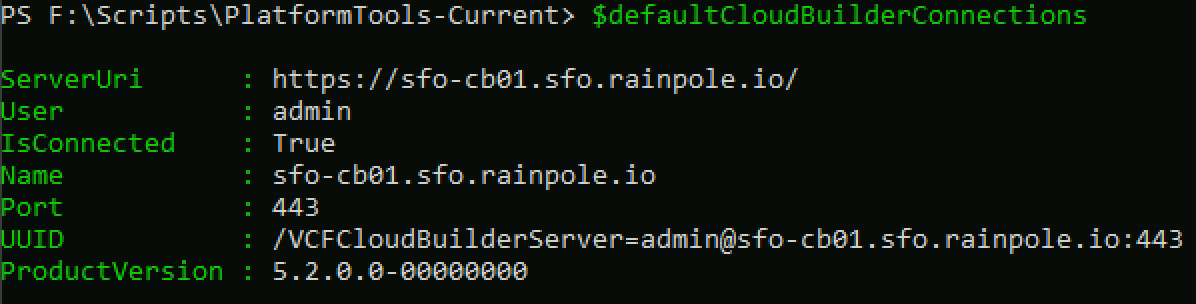
This connection object is then stored in $defaultsddcManagerConnections
Note: If you are working in a lab environment with untrusted certs you can pass -IgnoreInvalidCertificate to each of the above commands.
Once you have an active connection, you can begin to query the API. The example below returns a list of all hosts from SDDC Manager. One thing you will notice, if you are a PowerVCF user, is that you will need to parse the response a little more than you needed to with the PowerVCF cmdlet Get-VCFHost.
Running Invoke-VcfGetHosts will return a list of host elements
So to parse the response, you can do something like this, which will return the details of all hosts
But lets say you would like to filter the response to just the hosts from a specific workload domain. You first need the Id of the workload domain, in this case sfo-m01.
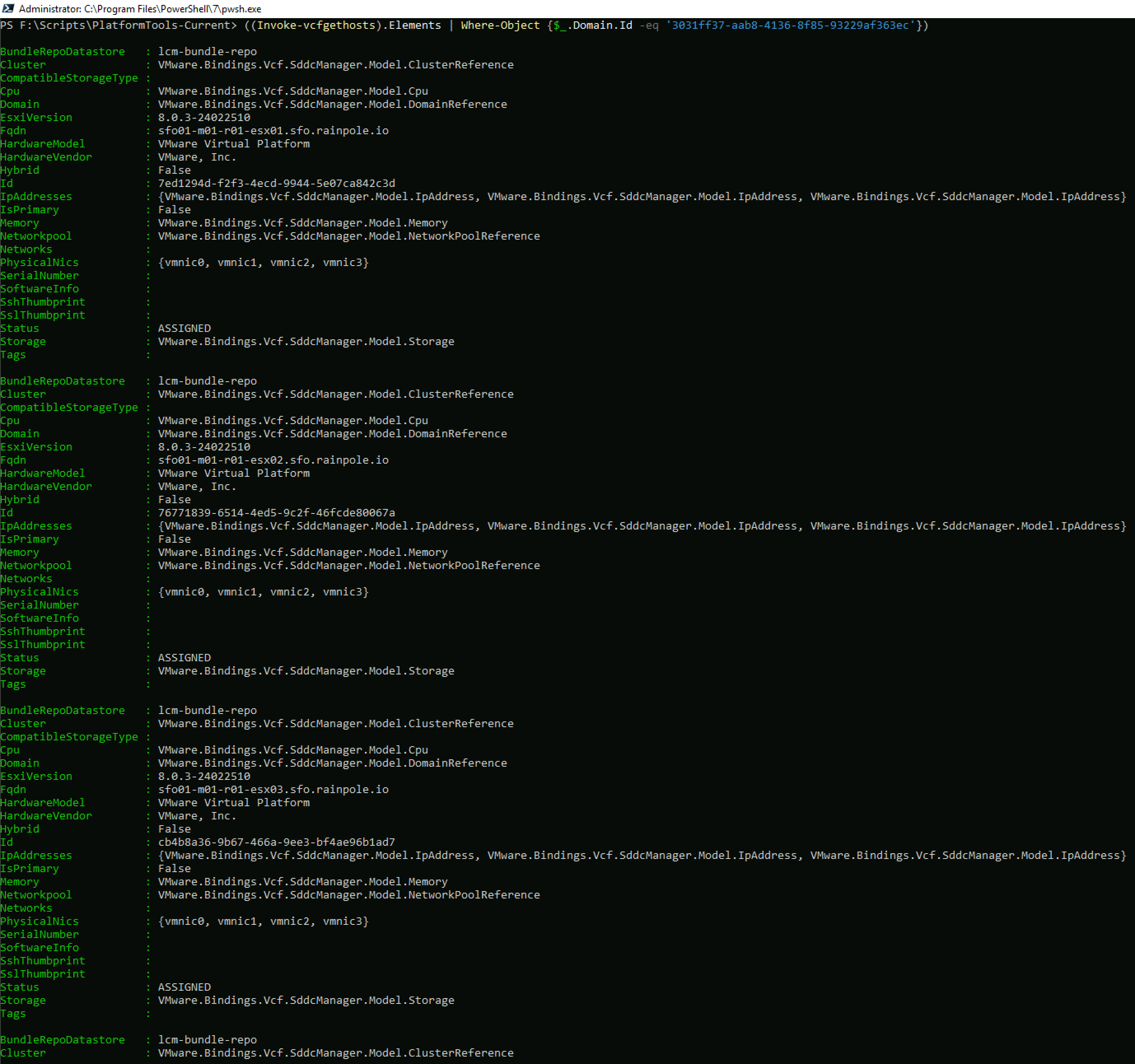
And you can then get a filtered list of hosts for that domain
Hopefully, this introduction was helpful, I will put together a series of blogs over the next few weeks covering some of the main VCF operations, such as bringup, commissioning hosts, deploying workload domains etc. As always, comments & feedback are welcome. Please let me know what your experience is with the new modules and I can feed it back to the engineering team.
I have covered how to clean up general failed tasks in Cleanup Failed Credentials Tasks in VMware Cloud Foundation in a previous post. Another type of task that can be in a failed state is a credentials rotation operation. Credential operations can fail for a number of reasons (the underlying component is unreachable at the time of the operation etc), and this type of failed task is a blocking task – i.e. you cannot perform another credential task until you clean up or cancel the failed task. The script below leverages the PowerVCF cmdlet Get-VCFCredentialTask to discover failed credential tasks and Stop-VCFCredentialTask to clean them up. As with all scripts, please test thoroughly in a lab before using it in production.
# Script to cleanup failed credential tasks in SDDC Manager
# Written by Brian O'Connell - Staff II Solutions Architect @ VMware
#User Variables
# SDDC Manager FQDN. This is the target that is queried for failed tasks
$sddcManagerFQDN = "sfo-vcf01.sfo.rainpole.io"
# SDDC Manager API User. This is the user that is used to query for failed tasks. Must have the SDDC Manager ADMIN role
$sddcManagerAPIUser = "administrator@vsphere.local"
$sddcManagerAPIPassword = "VMw@re1!"
# DO NOT CHANGE ANYTHING BELOW THIS LINE
#########################################
# Set TLS to 1.2 to avoid certificate mismatch errors
[Net.ServicePointManager]::SecurityProtocol = [Net.SecurityProtocolType]::Tls12
# Install PowerVCF if not already installed
if (!(Get-InstalledModule -name PowerVCF -MinimumVersion 2.4.0 -ErrorAction SilentlyContinue)) {
Install-Module -Name PowerVCF -MinimumVersion 2.4.0 -Force
}
# Request a VCF Token using PowerVCF
Request-VCFToken -fqdn $sddcManagerFQDN -username $sddcManagerAPIUser -password $sddcManagerAPIPassword
# Retrieve a list of failed tasks
$failedTaskIDs = @()
$ids = (Get-VCFCredentialTask -status "Failed").id
Foreach ($id in $ids) {
$failedTaskIDs += ,$id
}
# Cleanup the failed tasks
Foreach ($taskID in $failedTaskIDs) {
Stop-VCFCredentialTask -id $taskID
# Verify the task was deleted
Try {
$verifyTaskDeleted = (Get-VCFCredentialTask -id $taskID)
if (!$verifyTaskDeleted) {
Write-Output "Task ID $taskID Deleted Successfully"
}
}
catch {
Write-Error "Something went wrong. Please check your SDDC Manager state"
}
}
Before you can deploy a vSphere Lifecycle Manager (vLCM) image based cluster in VMware Cloud Foundation, you must first import an image into the Image Management Inventory in SDDC Manager. You can do this via the SDDC Manager UI for a pre existing cluster.
Or you can now use PowerVCF to import the image thanks to the addition of New-VCFPersonality (vLCM images are known as personalities in VCF hence the name of the cmdlet).
The sequence of events to be able to import an image is as follows:
Extract a vLCM image from a host that you wish to use in the workload domain. The host doesn’t need to be in the vCenter or SDDC Manager inventory
Create a temporary cluster in vCenter (must be created in a VCF workload domain) and assign the image from the previous step.
Import the image from the source cluster into SDDC Manager
To achieve step 1 we can use PowerCLI
# Variables

$sourceHostUrl = "https://sfo01-w01-esx01.sfo.rainpole.io"
$sourceHostBuild = "21495797"
$sourceHostRootPassword = "VMw@re1!"
$vcenterFQDN = "sfo-m01-vc01.sfo.rainpole.io"
$ssoUsername = "administrator@vsphere.local"
$ssoPassword = "VMw@re1!"
$vcenterDC = "sfo-m01-dc01"
$sddcManagerFQDN = "sfo-vcf01.sfo.rainpole.io"

# Retrieve the source host thumbprint

$response = [System.Net.WebRequest]::Create($sourceHostUrl)
$response.GetResponse()
$cert = $response.ServicePoint.Certificate
$sourceHostThumbprint = $cert.GetCertHashString() -replace '(..(?!$))','$1:'

# Connect to vCenter and import the image from the source host to the depot

connect-viserver -server $vcenterFQDN -user $vcenterUsername -password $vcenterPassword

$OfflineHostCredentials = Initialize-SettingsDepotsOfflineHostCredentials -HostName $sourceHostUrl -UserName "root" -Password $sourceHostRootPassword -Port 443 -SslThumbPrint $sourceHostThumbprint

$OfflineConnectionSpec = Initialize-SettingsDepotsOfflineConnectionSpec -AuthType "USERNAME_PASSWORD" -HostCredential $OfflineHostCredentials

Invoke-CreateFromHostDepotsOfflineAsync -SettingsDepotsOfflineConnectionSpec $SettingsDepotsOfflineConnectionSpec

# Create a temporary cluster and assign the image

$LcmImage = Get-LcmImage -Type BaseImage | where {$_.Version -match $sourceHostBuild}
$clusterID = (New-Cluster -Location $vcenterDC -Name 'vLCM-Cluster' -HAEnabled -DrsEnabled -BaseImage $LcmImage).ExtensionData.MoRef.Value

# Import the image to SDDDC Manager

Request-VCFToken -fqdn $sddcManagerFQDN -username $ssoUsername -password $ssoPassword

$vCenterID = (Get-VCFvCEnter | where {$_.fqdn -match $vcenterFQDN}).id

New-VCFPesonality -name "21495797" -vCenterId $vCenterID -clusterId $clusterID
That should import the new image into the SDDC Manager image repo for use creating a vLCM image based workload domain.
Since the introduction of subscription based licensing for VMware Cloud Foundation (VCF+) there are now 2 licensing modes in VCF (Perpetual or Subscription). To make it easier to identify the subscription status of the system and each workload domain we have added support for Get-VCFLicenseMode into the latest release of PowerVCF 2.3.0.1004.
I was chatting with my colleague Paudie O’Riordan yesterday about PowerVCF as he was doing some testing internally and he mentioned that a great addition would be to have the ability to find, and cleanup failed tasks in SDDC Manager. Some use cases for this would be, cleaning up an environment before handing it off to a customer, or before recording a demo etc.
Currently there isnt a supported public API to delete a failed task so you have to run a curl command on SDDC Manager with the task ID. So getting a list of failed tasks and then running a command to delete each one can take time. See Martin Gustafson’s post on how to do it manually here.
I took a look at our existing code for retrieving tasks (and discovered a bug in the logic that is now fixed in PowerVCF 2.1.5!) and we have the ability to specify -status. So requesting a list of tasks with -status “failed” returns a list. So i put the script below together to retrieve a list of failed tasks, loop through them and delete them. The script requires the following inputs
SDDC Manager FQDN. This is the target that is queried for failed tasks
SDDC Manager API User. This is the user that is used to query for failed tasks. Must have the SDDC Manager ADMIN role
Password for the above user
Password for the SDDC Manager appliance vcf user. This is used to run the task deletion. This is not tracked in the credentials DB so we need to pass it.
Once the above variables are populated the script does the following:
Checks for PowerVCF (minimum version 2.1.5) and installs if not present
Requests an API token from SDDC Manager
Queries SDDC Manager for the management domain vCenter Server details
Uses the management domain vCenter Server details to retrieve the SDDC Manager VM name
Queries SDDC Manager for a list of tasks in a failed state
Loops through the list of failed tasks and deletes them from SDDC Manager
Verifies the task is no longer present
Here is the script. It is also published here if you would like to enhance it
# Script to cleanup failed tasks in SDDC Manager
# Written by Brian O'Connell - Staff Solutions Architect @ VMware

#User Variables
# SDDC Manager FQDN. This is the target that is queried for failed tasks
$sddcManagerFQDN = "lax-vcf01.lax.rainpole.io"
# SDDC Manager API User. This is the user that is used to query for failed tasks. Must have the SDDC Manager ADMIN role
$sddcManagerAPIUser = "administrator@vsphere.local"
$sddcManagerAPIPassword = "VMw@re1!"
# Password for the SDDC Manager appliance vcf user. This is used to run the task deletion
$sddcManagerVCFPassword = "VMw@re1!"


# DO NOT CHANGE ANYTHING BELOW THIS LINE
#########################################

# Set TLS to 1.2 to avoid certificate mismatch errors
[Net.ServicePointManager]::SecurityProtocol = [Net.SecurityProtocolType]::Tls12

# Install PowerVCF if not already installed
if (!(Get-InstalledModule -name PowerVCF -MinimumVersion 2.1.5 -ErrorAction SilentlyContinue)) {
    Install-Module -Name PowerVCF -MinimumVersion 2.1.5 -Force
}

# Request a VCF Token using PowerVCF
Request-VCFToken -fqdn $sddcManagerFQDN -username $sddcManagerAPIUser -password $sddcManagerAPIPassword

# Disconnect all connected vCenters to ensure only the desired vCenter is available
if ($defaultviservers) {
    $server = $defaultviservers.Name
    foreach ($server in $defaultviservers) {
        Disconnect-VIServer -Server $server -Confirm:$False
    }
}

# Retrieve the Management Domain vCenter Server FQDN
$vcenterFQDN = ((Get-VCFWorkloadDomain | where-object {$_.type -eq "MANAGEMENT"}).vcenters.fqdn)
$vcenterUser = (Get-VCFCredential -resourceType "PSC").username
$vcenterPassword = (Get-VCFCredential -resourceType "PSC").password

# Retrieve SDDC Manager VM Name
if ($vcenterFQDN) {
    Write-Output "Getting SDDC Manager Manager VM Name"
    Connect-VIServer -server $vcenterFQDN -user $vcenterUser -password $vcenterPassword | Out-Null
    $sddcmVMName = ((Get-VM * | Where-Object {$_.Guest.Hostname -eq $sddcManagerFQDN}).Name)
}

# Retrieve a list of failed tasks
$failedTaskIDs = @()
$ids = (Get-VCFTask -status "Failed").id
Foreach ($id in $ids) {
    $failedTaskIDs += ,$id
}
# Cleanup the failed tasks
Foreach ($taskID in $failedTaskIDs) {
    $scriptCommand = "curl -X DELETE 127.0.0.1/tasks/registrations/$taskID"
    Write-Output "Deleting Failed Task ID $taskID"
    $output = Invoke-VMScript -ScriptText $scriptCommand -vm $sddcmVMName -GuestUser "vcf" -GuestPassword $sddcManagerVCFPassword

# Verify the task was deleted
    Try {
    $verifyTaskDeleted = (Get-VCFTask -id $taskID)
    if ($verifyTaskDeleted -eq "Task ID Not Found") {
        Write-Output "Task ID $taskID Deleted Successfully"
    }
}
    catch {
        Write-Error "Something went wrong. Please check your SDDC Manager state"
    }
}
Disconnect-VIServer -server $vcenterFQDN -Confirm:$False
Along with the release of VMware Cloud Foundation 4.3.1, we are excited to announce the general availability of the Site Protection & Disaster Recovery for VMware Cloud Foundation Validated Solution. The solution documentation, intro and other associated collateral can be found on the Cloud Platform Tech Zone here.
The move from VMware Validated Designs to VMware Validated Solutions has been covered by my team mate Gary Blake in detail here so I wont go into that detail here. Instead I will concentrate on the work Ken Gould and I (along with a supporting team) have been working to deliver for the past few months.
The Site Protection & Disaster Recovery for VMware Cloud Foundation Validated Solution includes the following to deliver an end-to-end validated way to protect your mission critical applications. You get a set of documentation that is tailored to the solution that includes: design objectives, a detailed design including not just design decisions, but the justifications & implications of those decisions, detailed implementation steps with PowerShell alternatives for some steps to speed up time to deploy, operational guidance on how to use the solution once its deployed, solution interoperability between it and other Validated Solutions, an appendix containing all the solution design decisions in one easy place for review, and finally, a set of frequently asked questions that will be updated for each release.
Disaster recovery is a huge topic for everyone lately. Everything from power outages to natural disasters to ransomware and beyond can be classed as a disaster, and regardless of the type of disaster you must be prepared. To adequately plan for business continuity in the event of a disaster you must protect your mission critical applications so that they may be recovered. In a VMware Cloud Foundation environment, cloud operations and automation services are delivered by vRealize Lifecycle Manager, vRealize Operations Manager & vRealize Automation, with authentication services delivered by Workspace ONE Access.
To provide DR for our mission critical apps we leverage 2 VCF instances with NSX-T federation between them. The primary VCF instance runs the active NSX-T global manager and the recovery VCF instance runs the standby NSX-T global manager. All load balancing services are served from the protected instance, with a standby load balancer (disconnected from the recovery site NSX Tier-1 until required, to avoid IP conflicts) in the recovery instance. Using our included PowerShell cmdlets you can quickly create and configure the standby load balancer to mimic your active load balancer, saving you a ton of manual UI clicks.
In the (hopefully never) event of the need to failover the cloud management applications, you can easily bring the standby load balancer online to enable networking services for the failed over applications.
Using Site recovery Manager (SRM) you can run planned migrations or disaster recovery migrations. With a single set of SRM recovery plans, regardless of the scenario, you will be guided through the recovery process. In this post I will cover what happens in the event of a disaster.
When a disaster occurs on the protected site (once the panic subsides) there are a series of tasks you need to perform to bring those mission critical apps back online.
First? Fix the network! Log into the passive NSX Global Manager (GM) on the recovery site and promote the GM to Active. (Note: This can take about 10-15 mins)
To cover the case of an accidental “Force Active” click..we’ve built in the “Are you absolutely sure this is what you want to do?” prompt!
Once the promotion operation completes our standby NSX GM is now active, and can be used to manage the surviving site NSX Local Manager (LM)
Once the recovery site GM is active we need to ensure that the cross-instance NSX Tier-1 is now directing the egress traffic via the recovery site. To do this we must update the locations on the Tier-1. Navigate to GM> Tier-1 gateways > Cross Instance Tier-1. Under Locations, make the recovery location Primary.
The next step is to ensure we have an active load balancer running in the recovery site to ensure our protected applications come up correctly. To do this log into what is now our active GM, select the recovery site NSX Local Manager (LM), and navigate to Networking > Load Balancing. Edit the load balancer and attach it to the recovery site standalone Tier-1.
At this point we are ready to run our SRM recovery plans. The recommended order for running the recovery plans (assuming you have all of the protected components listed below) is as follows. This ensures lifecycle & authentication services (vRSLCM & WSA) are up before the applications that depend on them (vROPS & vRA)
vRSLCM – WSA – RP
Intelligent Operations Management RP
Private Cloud Automation RP
I’m not going to go through each recovery plan in detail here. They are documented in the Site Protection and Disaster Recovery Validated Solution. In some you will be prompted to verify this or that along the way to ensure successful failover.
The main thing in a DR situation is, DO NOT PANIC. And what is the best way to getting to a place where you DO NOT PANIC? Test your DR plans…so when you see this…
Your reaction is this…
Trust the plan…test the plan…relax…you have a plan!
Hopefully this post was useful..if you want to learn more please reach out in the comments…if you’re attending VMworld and would like to learn more or ask some questions, please drop into our Meet The Experts session on Thursday.
Within a VMware Cloud Foundation instance, SDDC Manager is used to manage the lifecycle of passwords (or credentials). While we provide the ability to rotate (either scheduled or manually) currently there is no easy way to check when a particular password is due to expire, which can lead to appliance root passwords expiring, which will cause all sorts of issues. The ability to monitor expiry is something that is being worked on, but as a stop gap I put together the script below which leverages PowerVCF and also a currently undocumented API for validating credentials.
The script has a function called Get-VCFPasswordExpiry that accepts the following parameters
-fqdn (FQDN of the SDDC Manager)
-username (SDDC Manager Username – Must have the ADMIN role)
-password (SDDC Manager password)
-resourceType (Optional parameter to specify a resourceType. If not passed, all resources will be checked. If passed (e.g. VCENTER) then only that resourceType will be checked. Supported resource types are
PowerVCF is a requirement. If you dont already have it run the following
Install-Module -Name PowerVCF
The code takes a while to run as it needs to do the following to check password expiry
Connect to SDDC Manager to retrieve an API token
Retrieve a list of all credentials
Using the resourceID of each credential
Perform a credential validation
Wait for the validation to complete
Parse the results for the expiry details
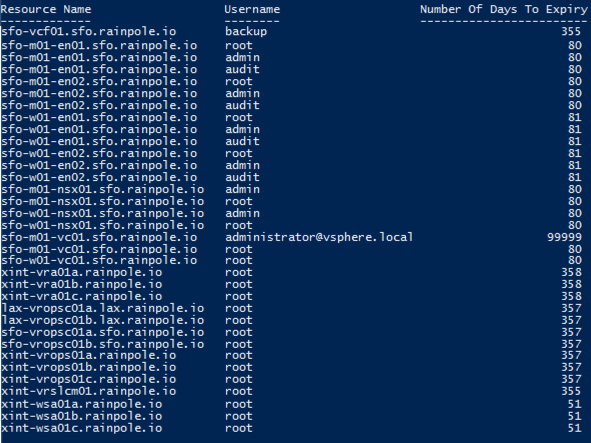
Add all the results to an array and present in a table (Kudos to Ken Gould for assistance with the presentation of this piece!)
In this example script I am returning all non SERVICE user accounts regardless of expiry (SERVICE account passwords are system managed). You could get more granular by adding something like this to only display accounts with passwords due to expire in less than 14 days
if ($validationTaskResponse.validationChecks.passwordDetails.numberOfDaysToExpiry -lt 14) {
               Write-Output "Password for username $($validationTaskResponse.validationChecks.username) expires in $($validationTaskResponse.validationChecks.passwordDetails.numberOfDaysToExpiry) days"
           }
PowerVCF 2.1.1 is now available on the PowerShell Gallery here or from GitHub here. This release includes support for VMware Cloud Foundation 4.1 with some new and updated cmdlets. Highlights below
Category
cmdlet Name
Description
Comment
Users and Groups
Get-VCFCredential
Retrieves a list of credentials.
UPDATE: Added support for the vRealize Suite credentials
Bundles
Start-VCFBundleUpload
Starts upload of bundle to SDDC Manager
UPDATE: Allows the import of a bundle based on offline download.
Federation
New-VCFFederationInvite
Invite new member to VCF Federation
UPDATE: Added support to specify if the new system is a MEMBER or CONTROLLER.
SDDC
Start-CloudBuilderSDDCValidation
Starts validation on VMware Cloud Builder
UPDATE: Added support for individual validation tasks.
Workspace ONE Access
Get-VCFWSA
Get details of the existing Workspace ONE Access
NEW
vRealize Automation
Get-VCFvRA
Get details of the the existing vRealize Automation
NEW
vRealize Operations
Get-VCFvROPs
Get details of the existing vRealize Operations Manager
NEW
vRealize Operations
Set-VCFvROPs
Connect or disconnect Workload Domains to vRealize Operations Manager
NEW
vRealize Log Insight
Get-VCFvRLI
Get details of the existing vRealize Log Insight
NEW
vRealize Log Insight
Set-VCFvRLI
Connect or disconnect Workload Domains to vRealize Log Insight
NEW
vRealize Suite Lifecycle
Get-VCFvRSLCM
Get details of the existing vRealize Suite Lifecycle Manager
UPDATE: Fixed an issue with the API URI and addressed response output







 LifeOfBrianOC